

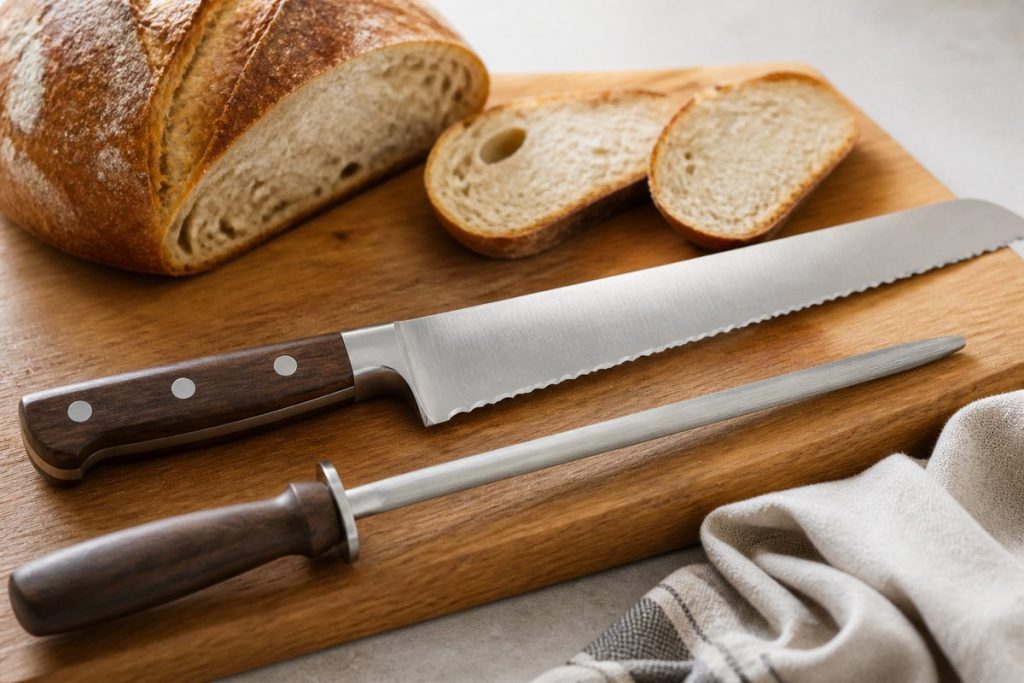
Quick answer: A serrated knife can be sharpened, but the process works differently than a straight edge. Instead of grinding one continuous bevel, you sharpen each pointed tooth and the curved valley behind it, using a tapered rod, a specialized sharpener, or a professional service. Get the technique wrong and you flatten the teeth instead of restoring them.
What you should also be asking:
- What are the best knife sharpening methods?
- What is used to sharpen a knife?
- What is the best material for a sharp knife?
- Which sharpening stone should a beginner choose?
- How should you care for a chef's knife?
Table of Contents
- Why Serrated Knives Are Different
- How Long Do Serrated Knives Stay Sharp?
- Signs Your Serrated Knife Is Getting Dull
- How Serrated Knives Are Actually Sharpened
- DIY vs. Professional Sharpening for Serrated Blades
- When a Serrated Knife Needs Repair, Not Just Sharpening
- Matching the Tool to the Damage
- The Anatomy of a Serrated Edge
- Step-by-Step: Sharpening a Serrated Edge by Hand
- Why the Wrong Tool Damages Serrations Instead of Sharpening Them
- When Professional Sharpening Makes More Sense
- Frequently Asked Questions
Why Serrated Knives Are Different
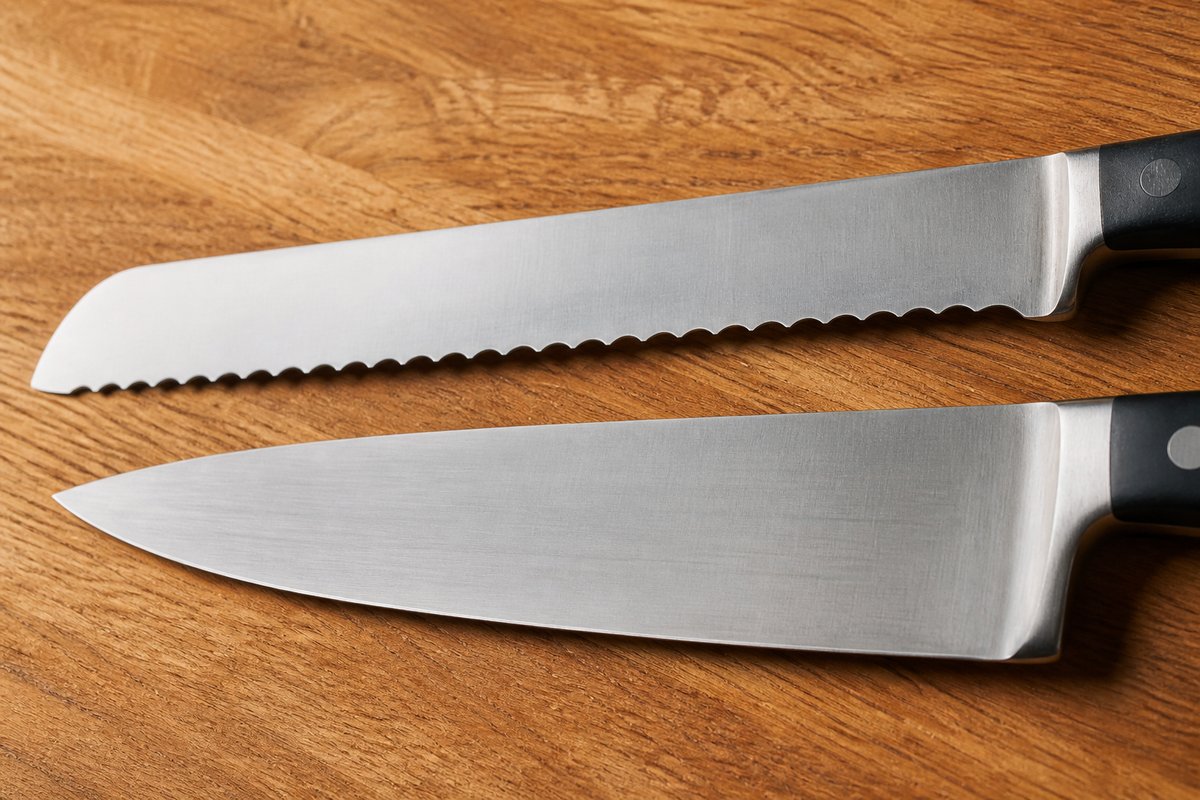
Serrated knives cut with a row of pointed teeth instead of one continuous edge. Each tooth grips the surface first, so the blade saws through crusty bread or tough skin without much downward pressure. The scalloped curves between the teeth, called gullets, do most of the actual cutting work as the blade moves back and forth.
A straight edged knife, like a chef's knife, relies on one long edge pressed straight down through food. A serrated blade works more like a small saw. That's why it holds up longer against tomatoes, bread crusts, and other foods with a tough outer layer and a soft interior.
How Long Do Serrated Knives Stay Sharp?
Serrated knives typically stay sharp for years under normal home use, longer than most straight edged knives. The teeth carry most of the cutting force, so the edge between them wears down slowly. That doesn't mean a serrated edge lasts forever. Heavy use, hard cutting surfaces, and frequent dishwasher cycles speed up the dulling process too.
For a full breakdown of what shortens a blade's edge life across knife types, see our guide on how long a knife stays sharp.
Signs Your Serrated Knife Is Getting Dull
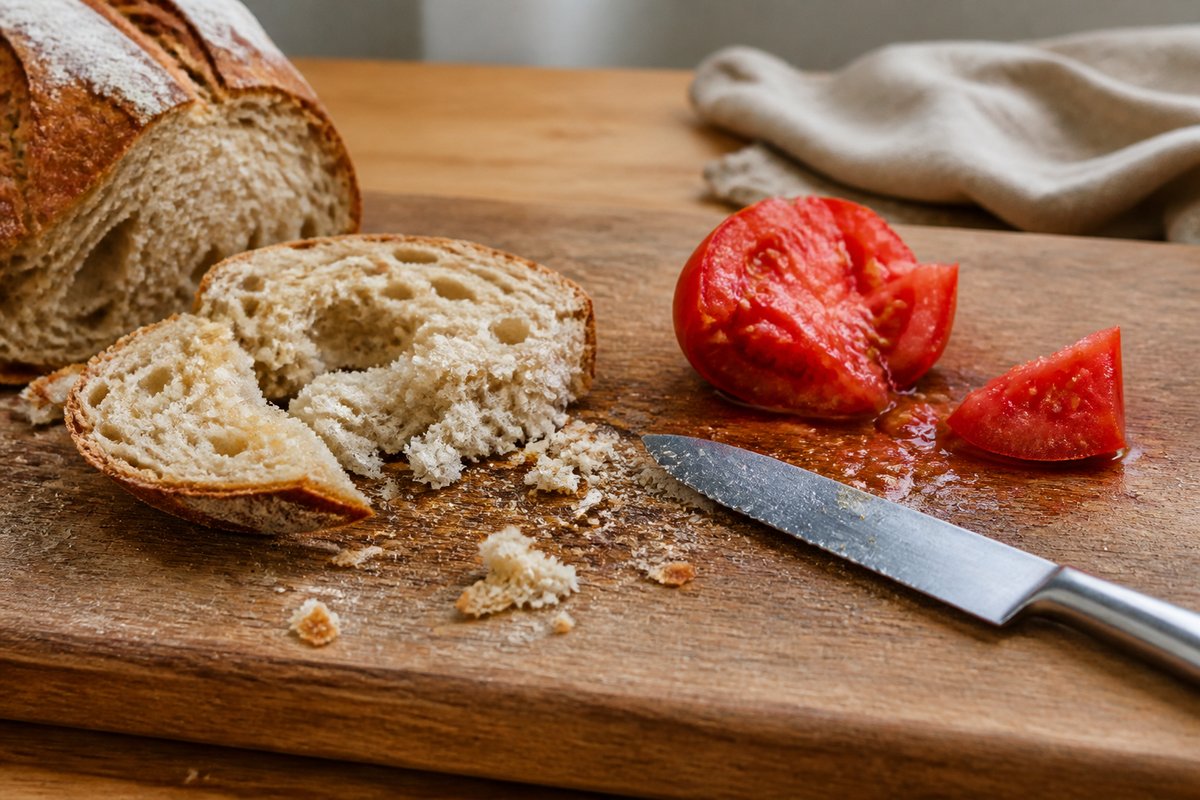
A dulling serrated knife stops slicing cleanly and starts tearing or crushing food instead. The change happens gradually, so it helps to know the specific signs rather than guessing by feel. Watch for these during normal use:
- Bread tears or crumbles instead of slicing into clean pieces
- Tomatoes squash under the blade before the skin breaks
- You need more force or more strokes to saw through the same food
- The teeth look rounded or shiny instead of pointed in good light
- Cuts come out ragged instead of straight
How Serrated Knives Are Actually Sharpened
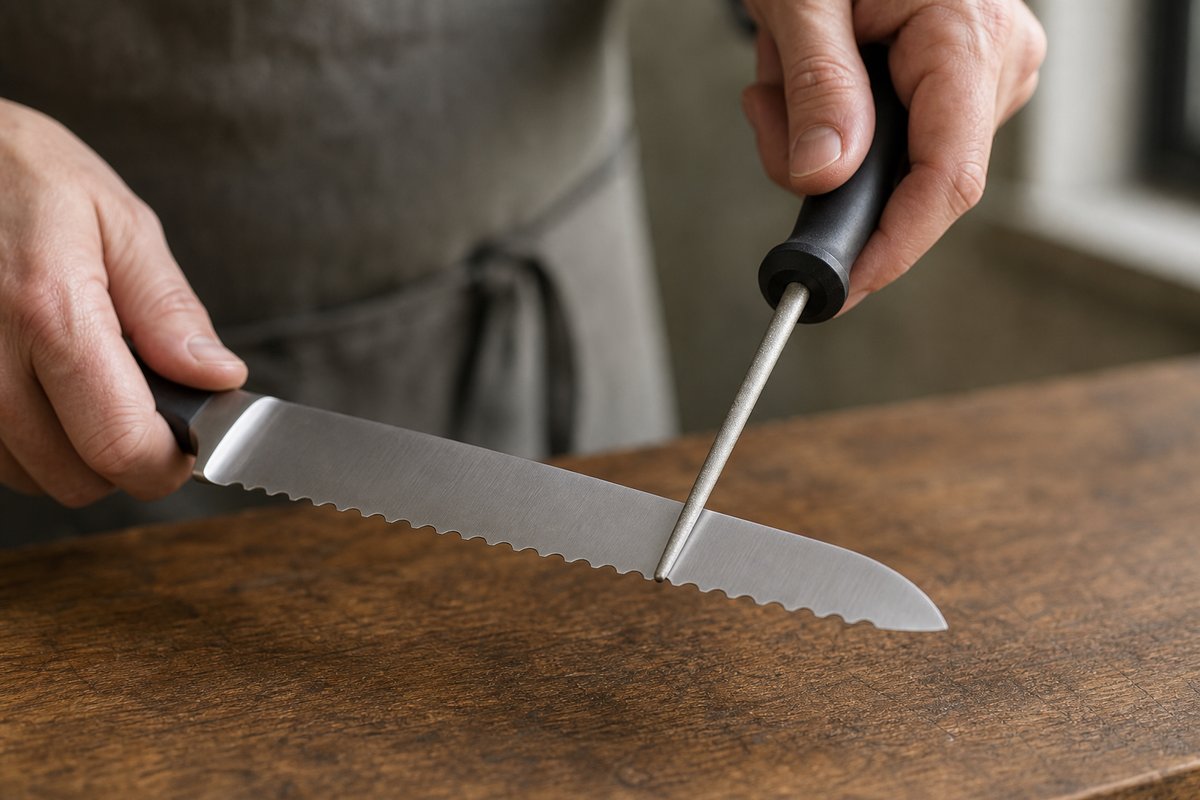
Sharpening a serrated knife means treating each tooth and gullet as its own small edge instead of one long line. You work a narrow, tapered tool into each curve, matching the existing bevel, rather than dragging a flat stone across the whole blade at once. The process takes longer than sharpening a straight edge but restores the same cutting action.
Sharpening Each Serration with a Tapered Rod
A tapered rod matches the curve of most gullets, which makes it the standard tool for touching up a serrated edge by hand. You run the rod through each gullet a few strokes at a time, following the bevel's existing angle, then move to the next tooth. Light pressure works better than force here.
Why a Regular Honing Rod Doesn't Work
A standard honing rod polishes and realigns a straight edge, but it can't reach the curves of a serrated blade. Honing rods are round and smooth, built to straighten a rolled edge, not to renew a bevel inside a tight gullet. Running one across serrations mostly rubs the high points and leaves the low points untouched.
If you want the technique for straight blades, see our guide on the honing rod technique for straight-edge knives.
Electric and Pull-Through Sharpeners: Mostly a Bad Fit
Most electric and pull-through sharpeners struggle with serrated blades. Their wheels or slots only touch the high points of the teeth, leaving the valleys where most cutting happens still dull. A few models include a small rod sized for serrations, but a generic straight-edge sharpener usually makes a serrated knife worse, not better.
For how these tools compare on straight blades, see electric and manual knife sharpeners.
DIY vs. Professional Sharpening for Serrated Blades
DIY sharpening works well for touch-ups between visits to a sharpening service, but a fully dull or damaged serrated edge is harder to restore at home than a straight blade. Matching the same angle and depth across every tooth by hand takes practice, and a mismatch between teeth shows up as an uneven, jagged edge.
| Factor | DIY at home | Professional sharpening |
|---|---|---|
| Best for | Light touch-ups, occasional dulling | Fully dull, damaged, or unevenly worn serrations |
| Tools needed | A tapered diamond or ceramic rod | Equipment matched to the blade's original grind |
| Consistency | Depends on a steady hand, tooth by tooth | Even results across the whole edge |
| Turnaround | A few minutes per touch-up | Same-day or next-day at most sharpening shops |
If you're weighing whether to try sharpening your knives yourself across your whole knife set, that question applies to serrated blades too. The same goes for what knife sharpening costs before you book a service.
When a Serrated Knife Needs Repair, Not Just Sharpening
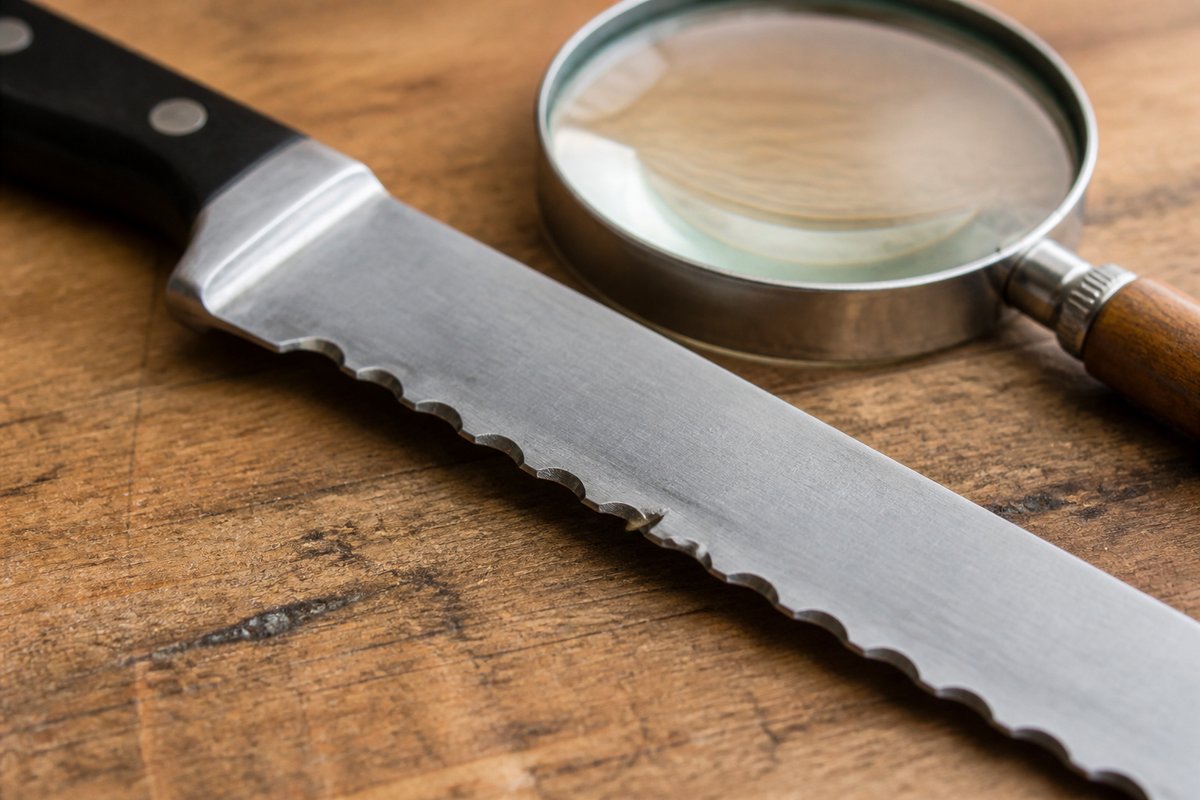
A serrated knife needs repair, not just sharpening, when the teeth themselves are damaged instead of just dull. Chipped, flattened, or unevenly worn teeth can't be fixed with a rod alone. In those cases, a sharpening service re-cuts the serration pattern into the blade, a process called re-serration, rather than touching up the existing edge.
A bent tip or a warped blade falls into the same category. These are structural problems, not edge problems, and forcing a sharpening tool onto a damaged blade can make the shape worse.
Matching the Tool to the Damage
A serrated knife isn't disposable just because it's lost its edge. The teeth and gullets need a different technique than a straight blade. That means a tapered rod for light touch-ups, or a professional service for a fully dull or damaged edge. Check for the warning signs above and match the tool to the job before deciding the knife is done.
Not sure if it needs sharpening or repair?
Bring the knife in and we'll tell you which one it needs before any work starts.
- 4-hour turnaround or less
- 2-hour drop-off service available
- Serving the greater Los Angeles area
For a more technical breakdown, continue below.
The Anatomy of a Serrated Edge
Most kitchen serrated knives use one of two grinds, and knowing which one you have determines where you sharpen. A chisel grind puts the bevel on one side only, leaving the other side flat. A double bevel cuts serrations into both sides evenly, closer to how a straight knife is ground.
Chisel-Ground vs. Double-Beveled Serrations
Many popular serrated bread knives use a chisel grind. One side stays flat, and the other side carries the primary bevel along with every tooth. Sharpening a chisel-ground blade means working the beveled side only, since sharpening the flat side would create a second bevel that changes how the edge cuts. A double-beveled serrated knife needs light, even attention on both sides instead, since both sides were ground to begin with.
Finding Your Blade's Original Grind
Hold the blade flat under direct light and look at each side of the teeth. One side will show a visible angled bevel catching the light. The other side will look flat, with no visible grind. Whichever side shows the bevel is the side you sharpen. Sharpening the wrong side on a chisel-ground knife alters the original grind and changes the edge's cutting behavior permanently.
Step-by-Step: Sharpening a Serrated Edge by Hand
Hand-sharpening a serrated edge means working one gullet at a time with a rod sized to fit the curve. Keep a consistent angle, then finish with a lighter pass to remove any burr. The order matters, since matching the tool and angle first prevents damage that's hard to correct later.
Choosing a Rod: Diamond vs. Ceramic
A diamond rod removes metal quickly and handles harder steel, which makes it the better choice for a genuinely dull edge that needs real material removed. A ceramic rod cuts more slowly and works well for light touch-ups or a finishing pass after a diamond rod. Rod diameter matters as much as material. A rod too wide can't reach the bottom of a small gullet, and a rod too narrow takes far more strokes to cover the same curve.
Matching the Angle and Working Each Gullet
Rest the rod against the existing bevel before you start, so the angle you feel is the angle already ground into the tooth, rather than guessing at a number. Push the rod into the gullet and pull it back out along the curve, repeating a few passes per tooth before moving to the next one. Keep pressure light and let the rod's abrasive do the work instead of forcing it.
Raising and Removing the Burr
A burr is a thin ridge of displaced metal that forms on the flat side of the edge once you've sharpened the beveled side enough to reach a true edge. You can usually feel it as a slight roughness when you run a finger carefully along the flat side. A few light passes on that flat side, or a pass with a finer finishing stone, removes the burr and leaves a clean edge behind.
Why the Wrong Tool Damages Serrations Instead of Sharpening Them
Tools built for a straight edge assume one continuous line of contact, which doesn't exist on a serrated blade. Using them anyway doesn't just fail to sharpen the knife. It actively grinds down the shape that makes a serrated edge work.
The Case Against Honing Rods on Serrated Edges
According to ZWILLING J.A. Henckels, you should never hone a serrated knife. It needs "to be sharpened by a professional or replaced" instead. That's because honing realigns a rolled edge on a straight blade without removing metal, but a serrated tooth that's lost its point needs metal actually removed to restore its shape. A honing rod can't do that work.
Why Electric Wheels Miss the Gullets
According to America's Test Kitchen, the valleys between a serrated blade's teeth make up most of the cutting edge, and most electric sharpeners only reach the tips. A spinning abrasive wheel is rigid and round, so it can't flex into a concave gullet the way a tapered rod can. Repeated passes through an electric sharpener grind the points shorter over time without ever renewing the edge inside each valley.
When Professional Sharpening Makes More Sense
A home rod fixes light dulling, but a blade with damaged or badly uneven teeth needs equipment and experience a kitchen drawer doesn't have. Professional sharpening for serrations isn't just a finer version of the same technique. It can involve rebuilding the tooth pattern itself.
Restoring a Serration Pattern (Re-serration)
Re-serration is the process of cutting a fresh set of teeth into a blade that's lost its original pattern to chipping, uneven wear, or repeated bad sharpening attempts. A sharpening service uses equipment built to cut a consistent tooth spacing and depth across the full length of the blade. That restores both the cutting action and the blade's original look.
What Manufacturer Guidance Says
According to Victorinox, larger wavy or serrated blades such as bread knives should be sharpened professionally, and only experienced users should attempt smaller wavy edges on their own. The reasoning holds up mechanically. Getting one tooth's angle slightly wrong is a minor issue. Getting several teeth wrong in different directions creates a jagged edge that's worse than the dull one you started with.
Frequently Asked Questions
Can you sharpen a serrated knife at home, or do you need a professional?
Yes, light touch-ups are doable at home on a serrated blade, using a tapered rod sized to fit the gullets. Match the rod to the existing bevel angle and work each tooth individually rather than dragging the rod across the whole edge at once. A fully dull or unevenly worn blade is harder to fix yourself, since every tooth needs the same angle and depth to cut evenly. If your knife tears bread instead of slicing it even after a touch-up, that's usually a sign to send it to a sharpening service instead.
Why won't a regular knife sharpener work on a serrated blade?
A regular sharpener, whether it's a pull-through tool or a flat sharpening stone, is built to grind one continuous straight edge. A serrated blade's edge isn't continuous. It's a row of points and curved valleys, and a flat or wheel-based tool can't reach into those valleys the way a shaped rod can. Forcing a straight-edge sharpener onto serrations tends to round off the points instead of restoring them, which permanently changes how the blade cuts.
Is it worth sharpening a serrated knife, or should I just replace it?
It's usually worth sharpening a serrated knife rather than replacing it, since the blade itself rarely wears out even after the edge dulls. A tapered rod or a professional sharpening service can typically restore a working edge for far less than the cost of a comparable new knife. Replacement makes more sense only when the blade is bent, cracked, or has lost several teeth to chipping, since those are structural problems that sharpening alone can't fix.
Does the cutting board you use affect how long a serrated edge lasts?
Yes. Hard cutting surfaces like glass, stone, or ceramic dull a serrated edge faster than wood or plastic, since they don't flex at all under the blade. Wood and soft plastic boards give slightly with each cut, which is easier on the teeth and the bevel behind them. This applies to straight blades too, but it tends to show up faster on serrated edges, since the individual points are already thin and prone to rounding off.
Can you use a leather strop on a serrated knife?
A leather strop works on a serrated knife, but only as a light finishing step, not as a way to sharpen a genuinely dull edge. Loaded with a polishing compound, a strop can remove a small burr and add a final polish to the beveled side after you've already restored the edge with a rod. It won't reshape a rounded tooth or fix uneven serrations, since a strop removes almost no metal compared to a diamond or ceramic rod.
My serrated bread knife still won't cut cleanly even after I touched it up myself. What went wrong?
This usually means the touch-up sharpened some teeth more than others, or missed the original bevel angle on one side of the chisel grind. A serrated edge only performs evenly if every tooth is sharpened to a matching depth and angle. Once a few teeth fall out of sync with the rest, the blade saws unevenly no matter how sharp any single tooth is. A professional re-serration resets every tooth to the same pattern at once, which is hard to replicate by hand once the edge is already inconsistent.
Do serrated steak knives need the same sharpening approach as a serrated bread knife?
The approach is the same in principle, but the tool size needs to match the tooth size. Steak knives typically have smaller, finer serrations than a bread knife. A rod sized for a bread knife's wide gullets is often too thick to seat properly in those smaller curves. Using an oversized rod on fine serrations tends to skip across several teeth at once instead of sharpening each one individually, which leaves the edge inconsistent.
Does a serrated knife need honing between sharpenings, like a straight knife does?
No. Honing works by realigning a rolled edge, which doesn't happen the same way on a serrated blade's individual teeth. Wiping the blade clean and dry after use does more to preserve a serrated edge between sharpenings than any honing tool would. The same goes for storing it so the teeth don't rub against other utensils.
Get your serrated knife slicing cleanly again
Professional sharpening and re-serration for bread, steak, and utility knives, plus everything else with an edge.
- Kitchen, pocket, and hunting knives
- Scissors, shears, and straight razors
- Mower blades, axes, and chainsaw chains
Published by Knife Sharpening Los Angeles
Human-researched · AI-assisted · Human-reviewed
How This Guide Was Prepared
This guide was researched by a human editor using manufacturer guidance, independent reference sources, and information relevant to professional knife sharpening. AI tools assisted with organizing and drafting the content.
Before publication, the complete article was reviewed and corrected by a human editor for accuracy, clarity, consistency, and alignment with the sources used during research.
Where a manufacturer or independent source makes a specific recommendation, we link directly to the original source so readers can review the guidance for themselves.
A Note on Knife Sharpening
Serration patterns, bevels, blade steels, and manufacturer recommendations vary between knives. The techniques described in this guide are general guidance and may not be appropriate for every blade.
Check the knife manufacturer's instructions when available. If the serrations are chipped, heavily worn, uneven, or you are unsure of the blade's original grind, professional inspection is preferable to removing additional material yourself.